
Have you ever dreamed of running a business where you don’t have to spend your weekends taping cardboard boxes or standing in line at the post office?
If so, you’ve probably heard of Amazon FBA.
In the world of e-commerce, Amazon FBA is often talked about as the “gold standard” for building a side hustle or a full-time brand. But what is it exactly? Is it still profitable in 2026? And most importantly, how do you get started without losing your shirt?
In this guide, we’re breaking down everything you need to know about Fulfillment by Amazon in simple, plain English. No jargon, just the facts.
📌 What is Amazon FBA? (The Simple Version)
FBA stands for Fulfillment by Amazon.
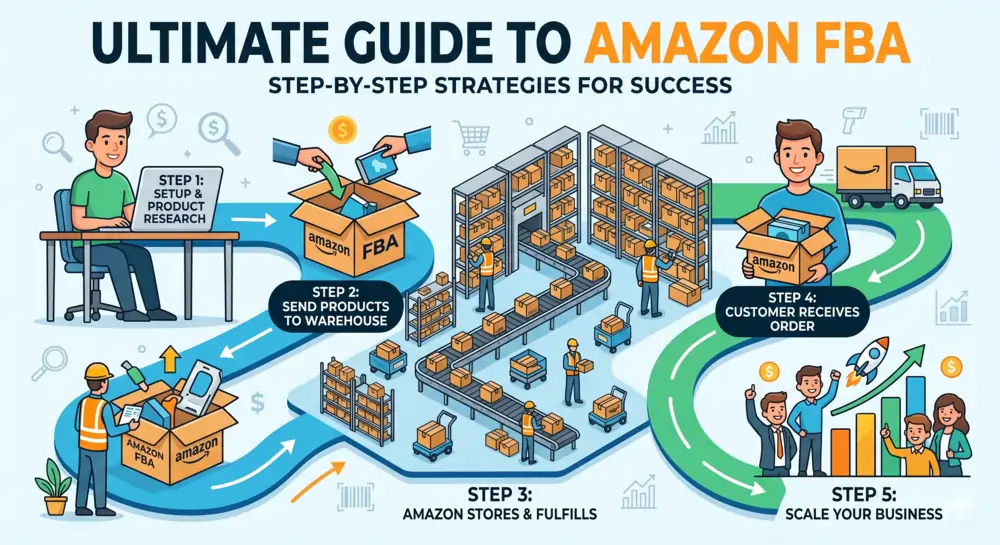
The concept is incredibly simple: You find the products, and Amazon does the heavy lifting. You send your inventory to one of Amazon’s massive warehouses (fulfillment centers). When a customer clicks “Buy Now,” Amazon picks the item off the shelf, packs it in a smiley-face box, and ships it to the customer.
They even handle the customer service and returns.
💡 FBA vs. FBM: What’s the Difference?
You might also see the term FBM (Fulfillment by Merchant). Here is the quick comparison:
| Feature | Amazon FBA | Amazon FBM |
| Storage | Amazon Stores it | You store it (garage/warehouse) |
| Shipping | Amazon ships it | You ship it |
| Prime Badge | Automatic eligibility | Harder to get |
| Customer Service | Handled by Amazon | Handled by you |
| Fees | Higher (Fulfillment fees) | Lower (You pay for shipping) |
🛠️ Why Should You Sell via Amazon FBA?
If Amazon is taking a cut of your money for these services, why do it? Because the perks are massive.
- The “Prime” Power: When you use FBA, your products automatically get the Amazon Prime badge. Millions of shoppers filter for Prime-only products because they want that sweet 1nday or 2-day shipping.
- Trust Factor: People trust Amazon. If there is a problem with an order, they know Amazon’s customer service will fix it. That trust transfers to your product.
- Scalability: You can sell 10 products or 10,000. Since you aren’t the one packing boxes, your business can grow as fast as your inventory allows.
- Global Reach: Amazon FBA makes it easy to sell in the US, Canada, UK, Europe, and beyond without needing a warehouse in every country.
How to Start Your Amazon FBA Business (Step-by-Step)
Starting a business can feel overwhelming, but if you follow these five steps, you’ll be ahead of 90% of the people who just “think” about doing it.
Step 1: Product Research (The Most Important Step)
You can’t just sell whatever you find in your attic. You need to find a product that has high demand but low competition.
- Look for “Boring” Products: Don’t try to invent the next iPhone. Look for everyday items like spatulas, yoga mats, or pet grooming brushes.
- Check the Numbers: Use tools like Jungle Scout or Helium 10 to see how much a product is actually selling per month.
- The “Small and Light” Rule: To keep your shipping costs low, aim for products that fit in a shoebox and weigh less than 2 lbs.
Step 2: Sourcing Your Product
Once you know what you want to sell, you need to find someone to make it. Most sellers use Alibaba to find manufacturers in China, but you can also look for local suppliers in the USA or Mexico.
- Order Samples: Never buy 500 units without seeing one first. Check the quality, the packaging, and how the supplier communicates.
- Negotiate: Don’t just take the first price. Be professional, but don’t be afraid to ask for a better deal as you grow.
Step 3: Create Your Amazon Seller Account
Go to sellercentral.amazon.com and sign up. You’ll have two choices:
- Individual Plan: $0.99 per item sold (Good if you’re selling less than 40 items a month).
- Professional Plan: $39.99 per month (Essential if you want to build a real brand).
Step 4: List Your Product and Optimize for SEO
This is where Amazon SEO comes in. If people can’t find your product, they won’t buy it.
- Keywords: Use high-intent keywords in your title (e.g., “Stainless Steel Garlic Press – Easy Clean – Professional Grade”).
- Photos: You need high-quality, professional images. The first photo must have a pure white background.
- Bullet Points: Don’t just list features; list benefits. Instead of saying “10-inch handle,” say “Long 10-inch handle to keep your hands safe from heat.”
Step 5: Send Your Inventory to Amazon
In Seller Central, you’ll create a “Shipping Plan.” Amazon will tell you which warehouse to send your boxes to. You print out labels, stick them on your boxes, and drop them off at UPS. Once they arrive and get scanned, your listing goes “Active,” and the sales can start rolling in!
The Real Cost: Amazon FBA Fees Explained
Let’s be real—Amazon isn’t a charity. They are going to charge you. To stay profitable, you need to understand your margins.
- Referral Fees: This is Amazon’s “commission” for letting you sell on their site. It’s usually around 15% of the selling price.
- Fulfillment Fees: This covers the picking, packing, and shipping. It’s based on the size and weight of the product.
- Storage Fees: You pay a monthly fee for the space your product takes up in the warehouse. Pro tip: Don’t let inventory sit for more than 6 months, or “Long-Term Storage Fees” will kick in.
3 Pro Tips for Success in 2026
The Amazon marketplace is more competitive than it used to be. To win today, you need a strategy.
1. Build a Brand, Not Just a Product
In the old days, you could just put a logo on a generic product and call it a day. Now, you need Brand Registry. This allows you to protect your listing from “hijackers” and gives you access to A+ Content (fancy descriptions with more pictures).
2. Master Amazon PPC (Advertising)
When you first launch, your product will be on page 10 of the search results. To get to page 1, you need to use Sponsored Products (PPC). You pay a small amount every time someone clicks on your ad. It’s the fastest way to get your first few sales and reviews.
3. Focus on Reviews (Legally!)
Reviews are the lifeblood of Amazon. Use the “Request a Review” button in Seller Central. Whatever you do, never pay for fake reviews. Amazon’s AI is incredibly good at spotting fraud, and they will ban your account faster than you can say “Prime.”
Is Amazon FBA Still Worth It?
The short answer: Yes.
The long answer: It’s not a “get rich quick” scheme anymore. It’s a real business that requires research, capital, and patience. However, with more people shopping online than ever before, the opportunity to build a 6 or 7-figure brand is still very much alive.
If you are willing to do the work that others won’t—like deep product research and high-quality branding—you can find massive success.
Ready to take the leap? Start by looking around your house today. What’s a problem you have that a simple product could solve? That might just be your first million-dollar idea.
❓ FAQ: Common Questions About Amazon FBA
💰 How much money do I need to start? While some people start with $500, a safer bet is $2,000 to $5,000. This covers your first inventory order, shipping, and some basic advertising.
🤔 Do I need a business license? You can start as an individual, but as you grow, it’s a good idea to form an LLC for legal protection.
⏱️ How long does it take to see a profit? Most sellers see a return on their investment within 3 to 6 months, depending on how fast their inventory sells.
Ready to Grow Your Amazon Business?
Let’s discuss how we can help you achieve your e-commerce goals
